“Candidates address school finances, leadership transition, and district priorities“
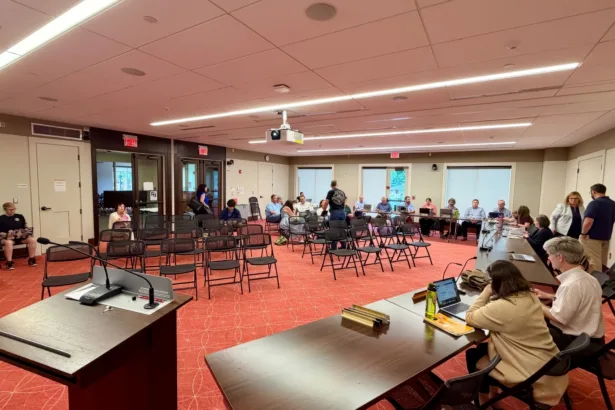
Three candidates for the Reading School Committee outlined their priorities and perspectives during a public forum hosted by Reading Recap on March 27th, giving residents a chance to hear directly from those seeking to serve as the district prepares for leadership transition and ongoing financial challenges.
The forum was moderated by Marianne Downing, a longtime Reading resident, Town Meeting member, and former Finance Committee member, who guided a wide-ranging discussion on the powers and responsibilities of the School Committee, budget pressures, curriculum decisions, technology use, and policy questions facing Reading Public Schools. Resident Marcel Dubois was the timekeeper.
Incumbent Erin Gaffen appeared alongside challengers Geoffrey Coram and Lori Lynn Hayes. All three candidates are competing for seats in the April 7th municipal election.
Backgrounds and Experience
Gaffen is seeking re-election after six years on the School Committee. She emphasized her “360-degree” perspective shaped by experience as a former special educator and administrator, a Town Meeting member, a local realtor, and a parent of three children at different educational stages. She pointed to accomplishments during her tenure, including the rollout of universal full-day kindergarten, expanded academic pathways in math and literacy, and progress on the new Killam Elementary School.
Coram highlighted more than two decades of volunteer involvement in Reading Public Schools. He has served as treasurer for multiple PTOs, assisted with securing nonprofit status for parent organizations, and continues to volunteer with the Reading Memorial High School drama program. Coram also serves on the town’s Finance Committee and previously filled an interim School Committee seat in 2019.
Hayes described herself as a highly engaged parent and volunteer who decided to run following the announcement that the current superintendent would be leaving the district. She emphasized hands-on involvement in literacy initiatives, classroom support, and community events, describing her approach as identifying needs and taking direct action.
Budget Pressures and Staffing Decisions
Much of the discussion focused on budget sustainability and how the district should respond if financial pressures intensify or an operating override fails in the future.
Gaffen said recent staffing additions, including instructional coaches, counselors, and assistant principals, are central to the district’s success and student support systems. She argued that cutting support positions could ultimately increase costs by driving more students out of district for specialized services. Her preference, she said, would be to explore enrollment distribution and staffing adjustments before eliminating positions.
Coram agreed that classroom teachers should remain the highest priority, while suggesting that some support roles may merit reassessment over time as new curricula mature. He emphasized the need to distinguish between legally mandated services and discretionary positions when making budget decisions.
Hayes said the district should first examine vacancies and positions left unfilled through attrition before considering cuts. She added that non-core roles may require evaluation if finances tighten, but stressed that transparency and clarity around decision-making are essential.
Class Size and Enrollment
Candidates also addressed resident concerns about uneven class sizes across schools.
Gaffen noted that the district follows clear class size guidelines and has improved consistency in recent years, while balancing the town’s commitment to neighborhood schools. She acknowledged that enrollment projections, especially at the kindergarten level, remain imperfect and require annual review.
Coram said school choice policies have provided flexibility by allowing the superintendent to assign students to schools with available space, helping reduce disparities without major boundary changes.
Hayes suggested that flexible staffing and enrollment strategies may help balance resources more equitably as the town navigates potential budget constraints.
Technology, Devices, and Artificial Intelligence
Candidates offered differing but overlapping perspectives on technology use in classrooms.
Gaffen characterized technology as a necessary but carefully balanced tool, emphasizing that traditional instruction remains central while digital literacy is increasingly required for testing and curriculum. She distinguished educational technology from cell phones and social media, which she said require different safeguards.
Coram supported district-controlled devices, saying they allow schools to manage student access and reduce distractions while preparing students for higher education and the workforce.
Hayes expressed concern about excessive screen time, especially in younger grades, arguing that reducing reliance on devices could benefit student well-being and potentially reduce long-term technology costs.
All three candidates supported developing a formal district policy on artificial intelligence. Gaffen stressed responsible use and preserving original thinking skills. Coram framed AI literacy as an essential workforce skill, while Hayes advocated for ongoing oversight through an advisory group, citing the rapidly evolving nature of AI and potential risks to students.
Unified Sports and Article 14
Unified Sports funding and Article 14 of the Town Meeting warrant generated significant discussion.
Gaffen said Unified Sports should be permanently funded as part of the school budget and not subject to recurring debate, expressing support for any sustainable funding mechanism that ensures long-term stability.
Coram voiced strong support for the program but raised concerns about relying on variable revenue from Burbank Ice Arena. He argued for a direct, predictable budget line item instead and noted that while he opposed Article 14 at Finance Committee, he supported adding funding directly into the school budget.
Hayes said there is broad agreement on the value of Unified Sports, with debate focused on funding mechanics. She said she intends to listen closely to Town Meeting discussion before taking a firm position and noted that program funding will likely need to grow as participation expands.
Preparing for a New Superintendent
With the district preparing to welcome a new superintendent, candidates emphasized the importance of continuity and communication.
Gaffen said her priority would be a smooth leadership transition that preserves the district’s positive trajectory and existing strategic plan. She cautioned against changes made solely for appearance rather than need.
Coram said the new superintendent must communicate effectively with the community, particularly around budget realities and the potential for future overrides, while learning the unique character of each school.
Hayes stressed relationship-building and observation, saying the incoming superintendent should take time to understand district culture, priorities, and expectations before implementing changes.
Community Engagement and Educational Outcomes
When asked what students should gain beyond core academics, candidates pointed to broader life skills. Gaffen highlighted civic engagement and community involvement. Coram emphasized understanding how local government and school funding work. Hayes stressed leadership development, arguing that students should recognize leadership in everyday actions, not just formal roles.
Looking Ahead to Election Day
The forum marked one of the final opportunities for voters to compare School Committee candidates side by side before the April 7 town election, with early voting available in advance.
All three candidates encouraged residents to stay informed, engage in community discussions, and participate in the upcoming election, emphasizing that decisions made now will shape the future of Reading Public Schools.
The complete forum can be seen below: