Depot Cam
 Override 2026
 Shop 01867
 AI Recaps
 LTE’s
LTE’s Police and Fire Scanner
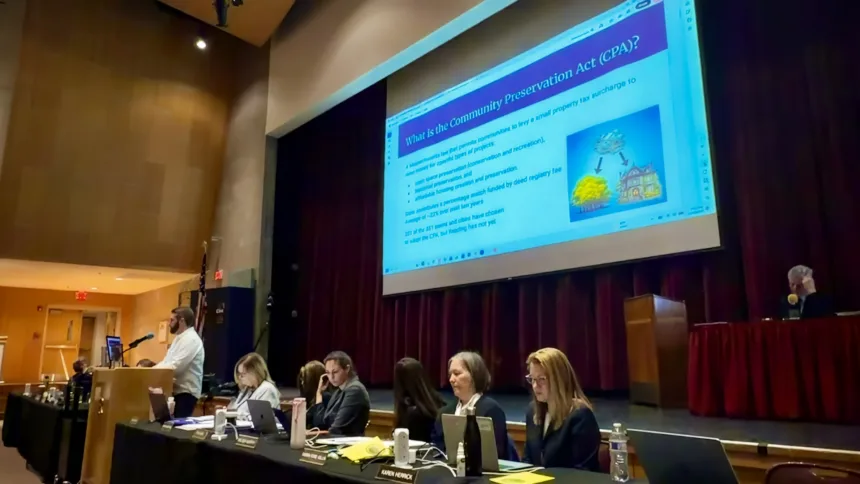
“Roll call vote sends Community Preservation Act to voters at November 2026 State Election“
Town Meeting members voted Monday night to advance the Community Preservation Act (CPA) to the voters, approving Article 13 after extended debate and setting the stage for a town wide decision at the November 3, 2026 State Election. The vote authorizes placement of the CPA question on the ballot; it does not itself adopt the law.
Following debate and a required roll call, Town Meeting approved Article 13 by a vote of 106 in favor and 60 opposed. Earlier in the discussion, members also voted by a two thirds margin to close debate before proceeding to the roll call vote.
What the Community Preservation Act Would Do
If approved by voters, the CPA would establish a dedicated funding source through a local property tax surcharge that would be supplemented by state matching funds derived primarily from Registry of Deeds fees. The CPA Study Committee recommended a 1 percent surcharge, which members said could generate roughly $700,000 in local funds annually, with additional state matching revenue that has averaged between 20 and 25 percent historically. Combined, Reading could see close to $1 million per year for eligible projects.
CPA funds are restricted by state law to capital projects in four categories: open space preservation, affordable housing, historic preservation, and recreational facilities. At least 10 percent of annual CPA revenue must be spent in each of the first three categories, with the remaining funds allocated at Town Meeting’s discretion. Funds may not be used for routine maintenance or most operating expenses.
The proposal includes several exemptions intended to limit the impact on vulnerable residents. The first $100,000 of residential property value would be exempt from the surcharge, as would all commercial and industrial properties. Additional exemptions would apply to low income households and qualifying low and moderate income seniors. Study committee members said the typical homeowner would pay about $90 to $100 per year, depending on assessed value.
Supporters Emphasize Long Term Investment and State Funds
Supporters argued that adopting the CPA would allow Reading to leverage state matching dollars for projects the town already undertakes, reducing the reliance on general taxation for improvements to parks, historic buildings, recreational facilities and affordable housing initiatives. Several speakers noted that more than 200 Massachusetts communities have adopted the CPA, and that no municipality has repealed it in the 25 years since the law was enacted.
Members of the CPA Study Committee outlined the committee’s two year review process, which included consultation with town boards, community groups, and peer municipalities. They emphasized that Town Meeting would retain final authority over all CPA spending, and that adopting the CPA would simply give Reading access to a dedicated funding tool already widely used across the state.
Concerns Focused on Timing and Tax Impact
Opponents of the measure raised concerns primarily about affordability and timing, emphasizing the broader fiscal context facing the town. The CPA question is expected to appear on the same ballot alongside a Proposition 2½ override, raising concerns among some members about voter fatigue and the cumulative tax impact.
Several Town Meeting members argued that asking voters to consider two tax related measures at the same election could complicate decision making and reduce the likelihood of approval for either proposal. Others expressed concern that, even with exemptions, the additional surcharge could add pressure on residents already grappling with rising costs, particularly those on fixed incomes.
Some speakers also questioned whether Town Meeting should defer the decision to a ballot vote, suggesting instead that preservation and recreation priorities could continue to be addressed through the existing capital planning and budget process. While acknowledging the potential benefits of CPA funding, critics cautioned that the combined impact of multiple fiscal initiatives warranted careful consideration.
The Road Ahead
With Town Meeting approval secured, the CPA question will be presented to voters at the November 3, 2026 State Election. If voters approve the measure, Reading would establish a Community Preservation Committee to solicit and review project applications, which would then return to Town Meeting for funding approval. If voters reject the question, the CPA would not take effect.
Monday night’s vote ensures that the final decision rests with the broader electorate, marking the first time in decades that Reading voters will weigh whether to adopt the Community Preservation Act and join the majority of Massachusetts communities already using the program.