


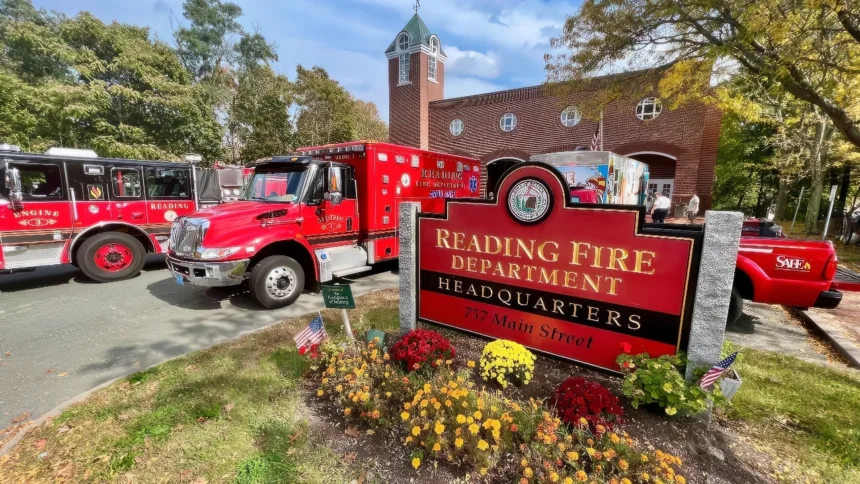
Aligning Resources to Meet Community Safety Goals
The Reading Fire Department is requesting a 4.01% increase in its fiscal year 2027 budget, citing the need to sustain minimum staffing levels, cover rising overtime costs, and maintain critical emergency medical services. Fire Chief Rick Nelson presented the proposal during last Monday night’s Select Board meeting, emphasizing that the department’s role extends far beyond fighting fires.
Our mission is to protect lives, property, and the environment,” Nelson said. “Fire prevention and EMS are just as important as suppression.”
Nelson explained that the department operates with 51 uniformed personnel divided into four groups, each scheduled for 24-hour shifts. Ideally, each group has 12 firefighters, but retirements and hiring delays meant that full staffing was never achieved in 2025. “We never hit 12 all year,” Nelson noted. “Most days we were at 10, which is the contractual minimum.”
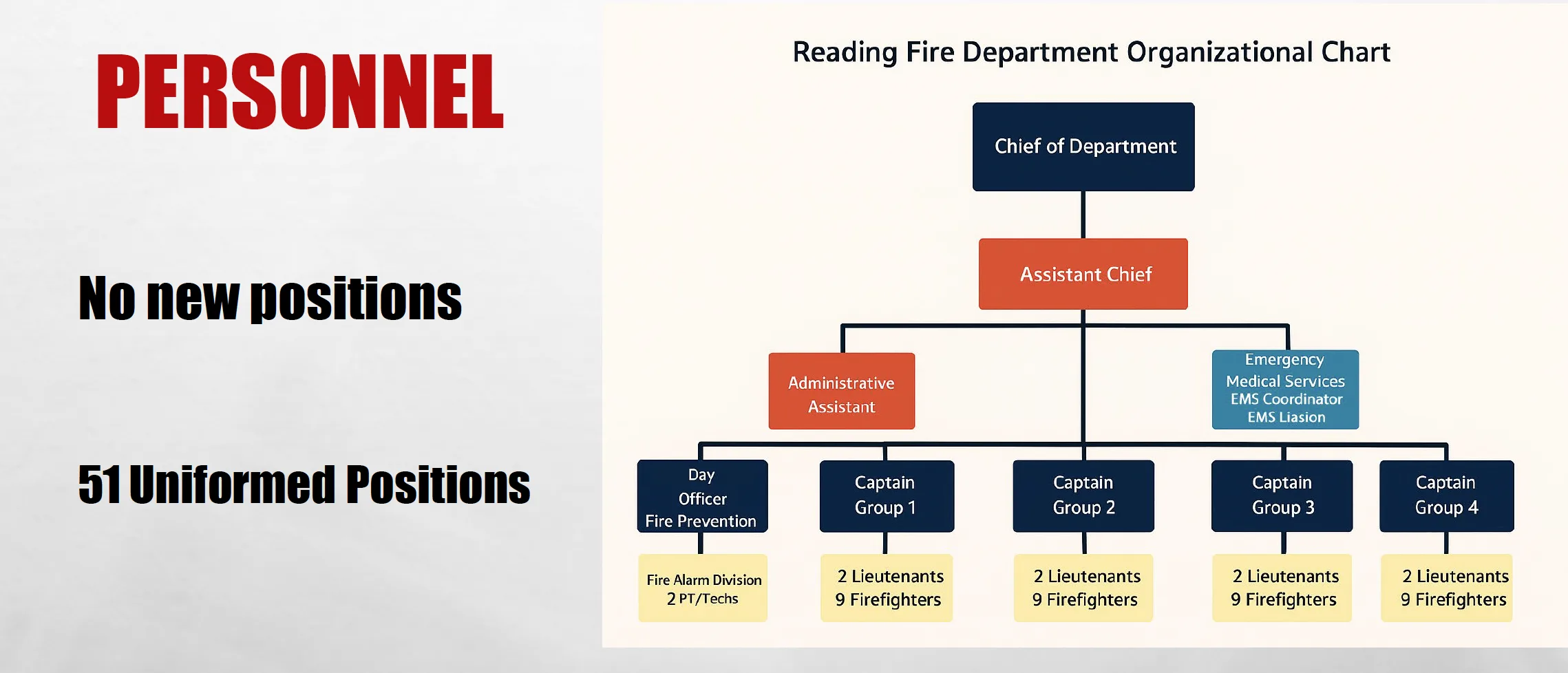
That minimum matters. With 10 firefighters, the department can staff two engines, a ladder truck, and an ambulance—but efficiency suffers. “Dragging a hose line through a house with two people instead of three is brutal,” Nelson said. “It slows everything down and limits what else we can do.”
The proposed FY27 budget totals $6.8 million, with 89% tied to union salaries, 7% to non-union salaries, and 4% to expenses. Outfitting a new firefighter costs roughly $9,000 to $10,000, Nelson said, and the expense budget also covers turnout gear, EMS supplies, and equipment maintenance.
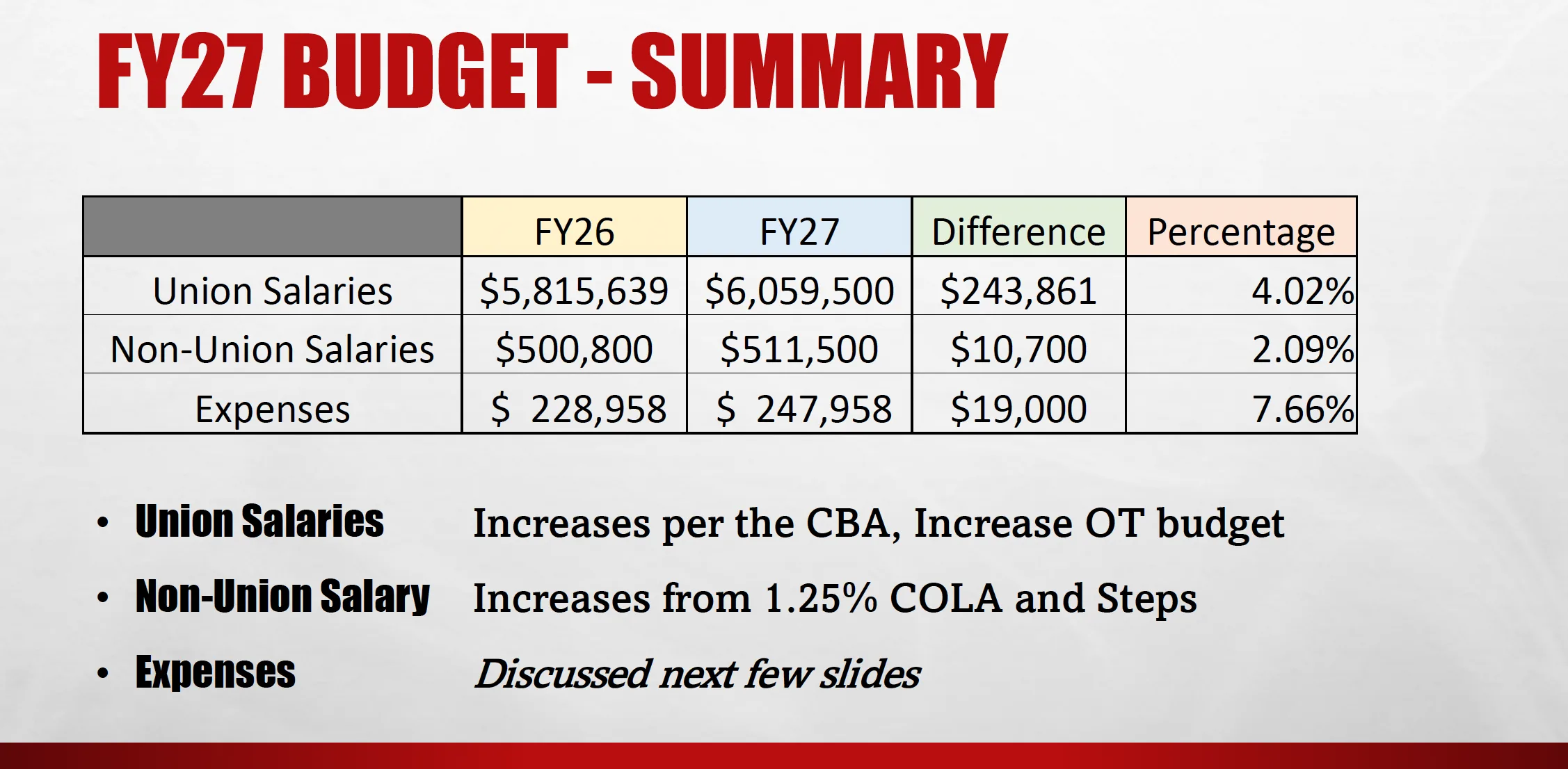
A major driver of the increase is overtime, which Nelson called “the bane of our budgeting system.” The department seeks to raise its overtime line from $530,000 to $600,000, largely to cover staffing gaps and prepare for a contractual change in FY28 that will remove the fire prevention officer from minimum manning calculations. “That change alone could add $50,000 to $80,000 in overtime,” Nelson warned.
Emergency medical services remain a cornerstone of the department’s work—and its budget. About $159,000 funds the advanced life support program, covering licensing fees, medical affiliations, and mandated equipment. New state requirements, such as a CLIA waiver for blood glucose testing, add costs. “We’re now considered a mobile lab,” Nelson said.
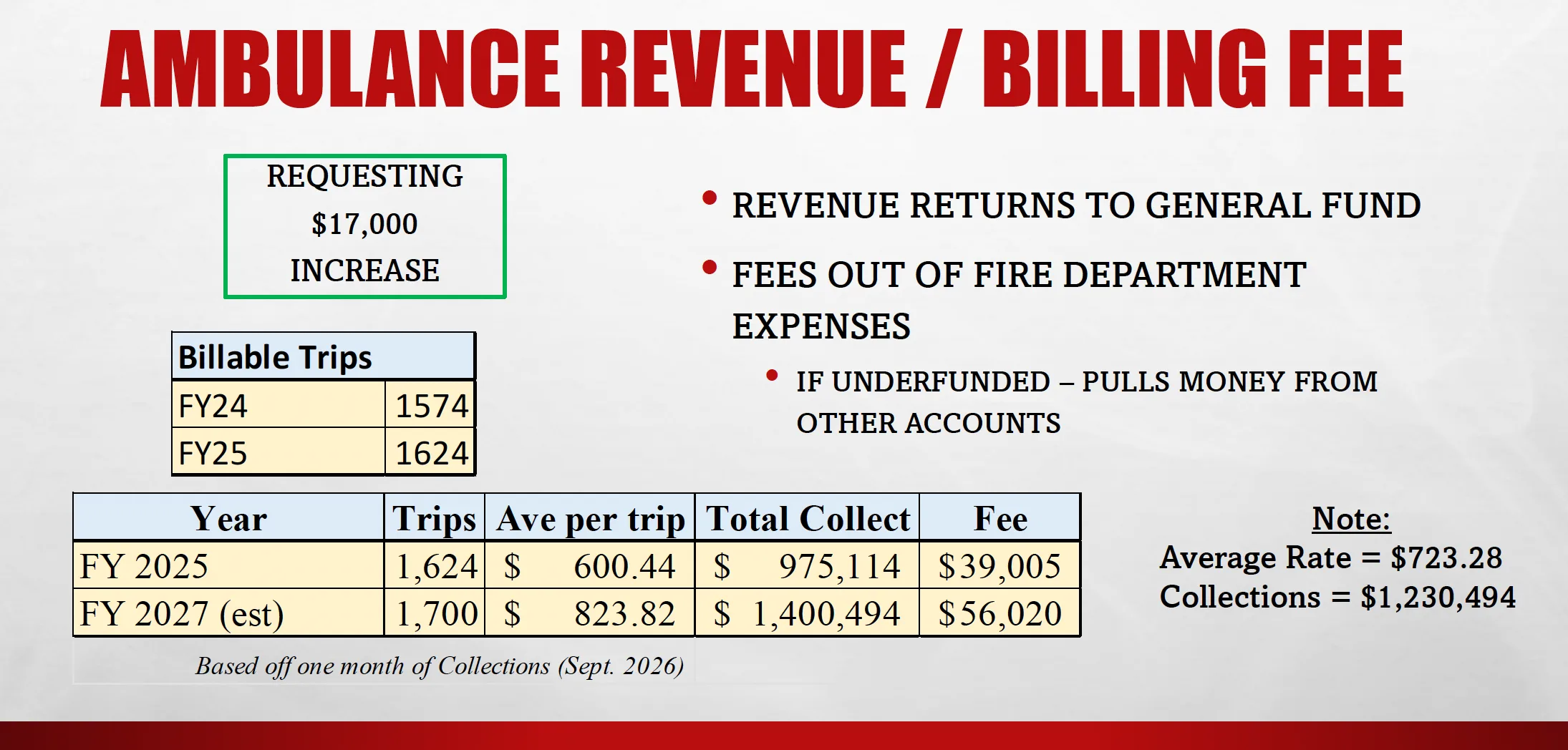
Ambulance billing fees also require attention. The town collects millions in EMS revenue, but the department pays a 4% processing fee from its expense budget. With billing changes boosting per-trip revenue from $600 to $823, Nelson expects overall collections to rise by $250,000 to $300,000, but needs $17,000 more to cover fees.
Despite these pressures, Nelson noted that grants have long supplemented Reading’s fire budget, funding gear and offsetting overtime. In FY25, the department secured $23,000 for equipment and $14,000 for safety programs. A recent FEMA Assistance to Firefighters Grant delivered $85,000 for a weeklong training program that modernized Reading’s incident command system. “It’s going to improve communication, accountability, and resource efficiency,” Nelson said. “Quicker actions mean better survivability and firefighter safety.”
Looking ahead, Nelson stressed that firefighting is only part of the job:
We handle hazardous materials, carbon monoxide calls, medicals, car accidents, alarms—you name it,” he said. “We’re an all-hazards department now.”