
 Depot Cam
 Override 2026
 Shop 01867
 AI Recaps
 LTE’s
LTE’s Police and Fire Scanner

“Finance Committee outlines structural deficit, tax impact concerns, and timeline for potential November vote”
Town officials formally launched discussion of a potential operating override during a May 20th joint Finance Committee and Select Board meeting, outlining a growing structural deficit and beginning what is expected to be a months-long public process to determine next steps.
The “financial forum” session focused on the fiscal outlook for FY28, with town administrators and finance officials presenting early projections, key cost drivers, and preliminary options for closing a widening budget gap.
Structural Deficit Driving Discussion
Officials said the town is facing an estimated structural deficit of approximately $6.5 million, driven largely by costs that have increased faster than allowable revenue growth under Proposition 2½.
Finance staff explained that while most departments have held spending increases to about 3 to 4 percent annually, major “accommodated costs” have grown significantly faster over the past five years. Those include employee benefits, which account for roughly $3.2 million of the gap, along with energy costs and other fixed obligations.
Overall cost increases in these categories were described as rising about 36% over five years, compared to closer to 16 percent growth for the rest of the budget during the same period.
Officials emphasized that these pressures are largely outside the town’s direct control, making it increasingly difficult to maintain service levels without additional revenue.
Projected Gap Expands in Future Years
Looking ahead to FY28, finance projections show a significantly larger gap depending on budget assumptions.
Using a more typical operating budget increase of about 3.75 percent, officials estimated a total deficit approaching $10 million before accounting for free cash or other offsets.
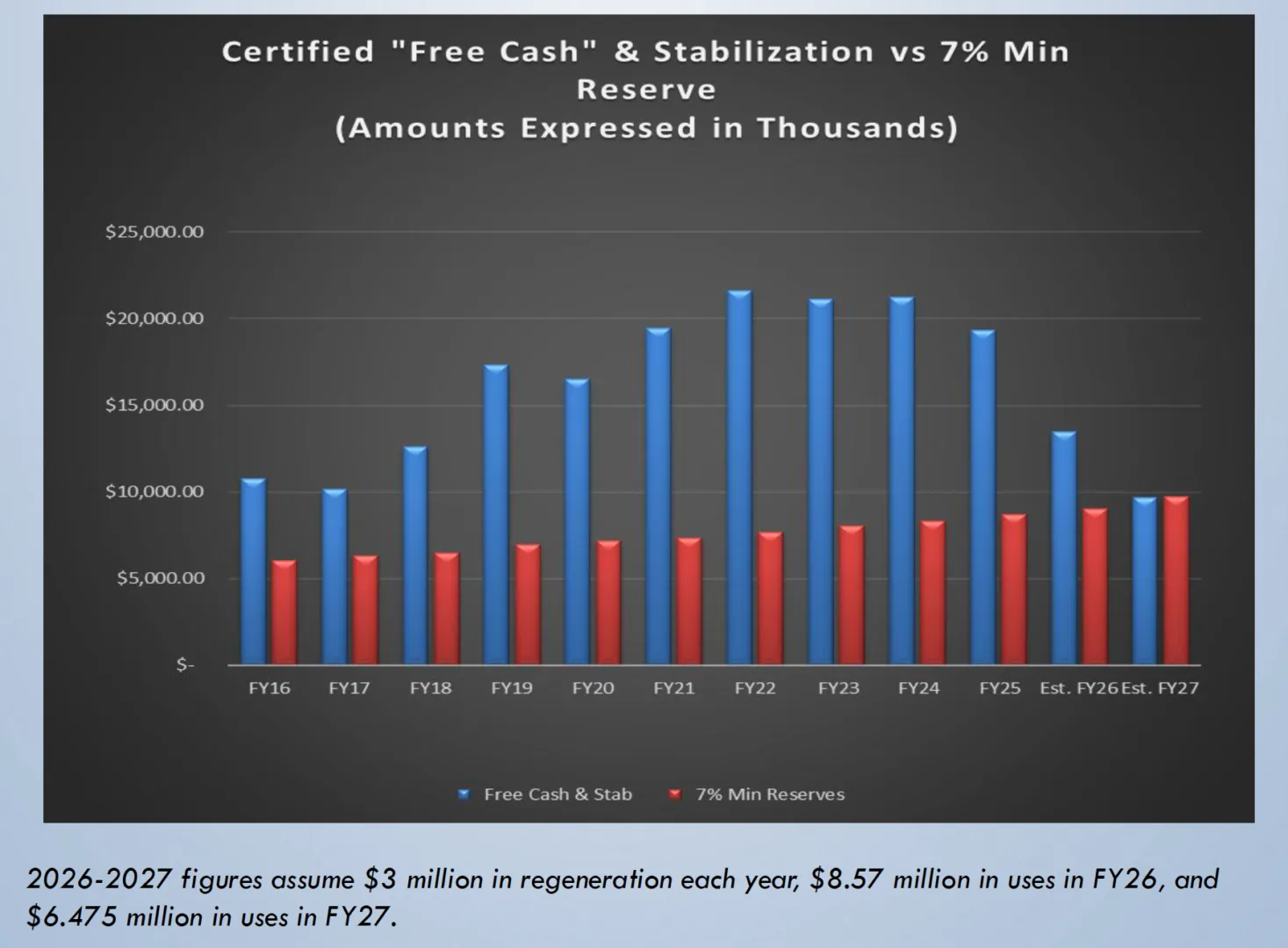
Much of that increase reflects new costs tied to recently approved capital projects, including staffing, insurance, and energy expenses for new school buildings. Those new obligations alone total close to $1 million annually.
Even under more conservative assumptions, officials indicated that the town would still face a substantial funding shortfall.
Override Seen as Primary Option
Town officials said an override is the primary mechanism available to close the gap while maintaining services.
A preliminary estimate presented during the meeting suggested that an override of roughly $7.5 million would represent a baseline level needed to sustain current services.
Finance staff cautioned that smaller override amounts would not fully address the underlying deficit, while larger amounts may be necessary to maintain services over multiple years.
Discussion also highlighted the challenge of striking a balance between a sufficiently large override and one that voters are willing to approve.
Potential Service Reductions Without Override
Officials said failure to pass an override would likely result in reductions across town departments, with staffing identified as the most significant area of impact.
“It’s people,” Town Manager Jayne Wellman said, explaining that personnel costs make up the bulk of the budget and represent the only place where deep reductions could occur at the scale required.
Under one scenario presented, a no-override budget would result in minimal growth of less than one percent, requiring cuts to services, positions, and operating expenses.
Town administrators said future budget presentations will outline specific reduction scenarios, including potential impacts on staffing, hours of operation, and maintenance services.
Tax Impact and Voter Considerations
The financial analysis also included estimated impacts on taxpayers.
Based on current projections, a $7.5 million override could increase the annual tax bill for an average home valued at approximately $944,000 by about $850 per year.
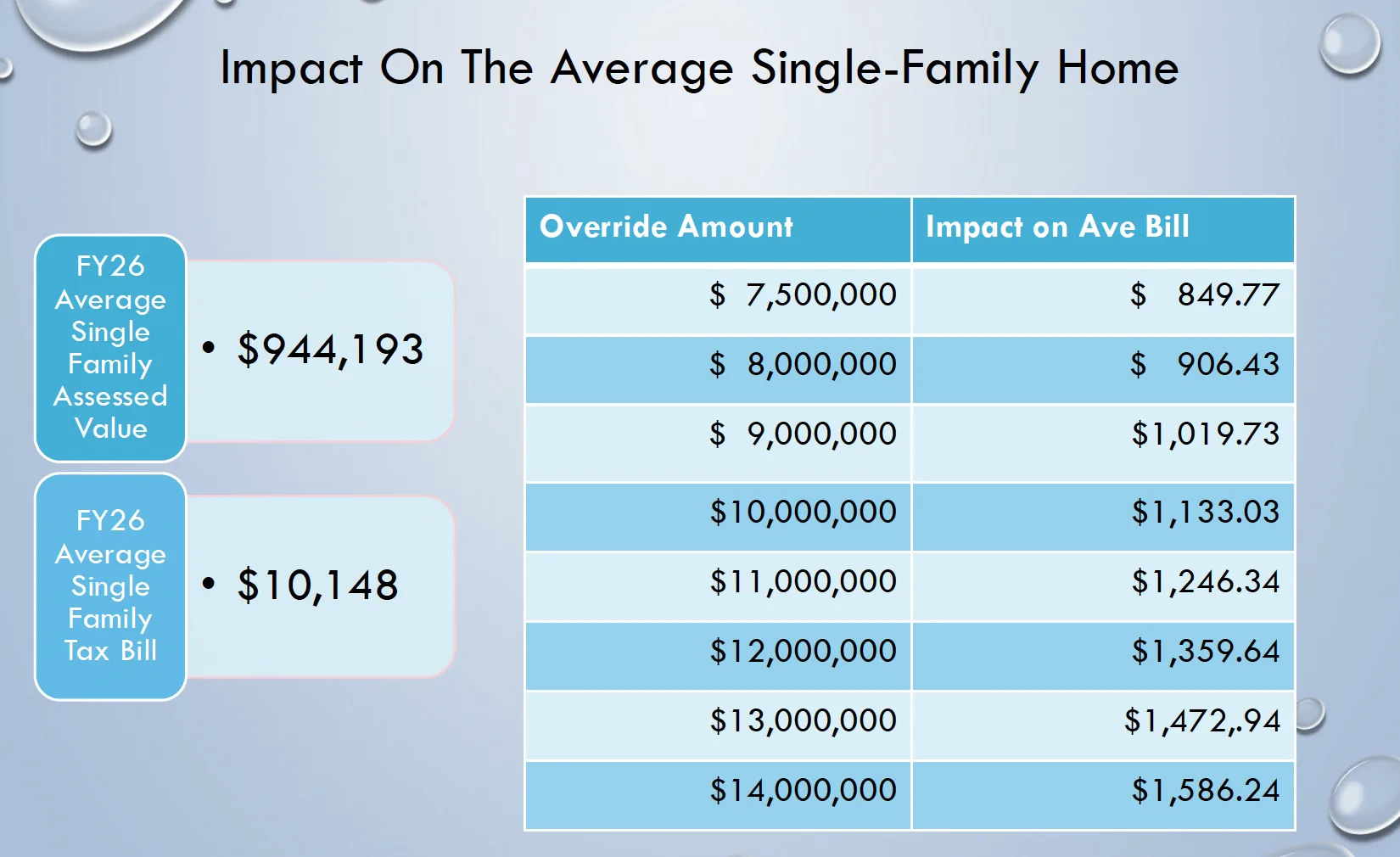
Officials noted that these figures do not yet include additional expected increases related to school building debt and other ballot questions that may appear alongside the override.
Committee members acknowledged that overall tax fatigue and economic conditions could play a significant role in shaping voter response.
Timeline Targets November Ballot
The Select Board is currently targeting placement of a potential override question on the November 3 state election ballot. Officials said this timing avoids the cost of a separate election and allows for maximum voter participation. To meet that deadline, the town must finalize the override amount and ballot language by early August, with internal decisions expected by mid-July.
A later vote was described as impractical due to the town’s budget timeline, which requires finalization of spending plans ahead of Town Meeting in early 2027.
Public Engagement Plan Taking Shape
Recognizing the scope of the decision, officials outlined a comprehensive public outreach effort. The proposed plan includes public forums, online webinars, a dedicated website, informational materials, and a tax impact calculator.
Additional meetings are expected throughout the summer and fall, with an emphasis on increasing participation. Committee members also advocated for earlier engagement, including a potential forum in June, to ensure residents are informed before final decisions are made.
Officials said the town will provide factual information only, in accordance with state law, while independent ballot question committees may advocate for or against the override.
Multiple Options Under Consideration
Committee members also discussed whether to present voters with more than one override option.
Some expressed support for offering two or three choices, allowing residents to weigh different levels of service and taxation. Others raised concerns that multiple questions could confuse voters or split support.
No decision has been made, but officials said they will continue evaluating possible approaches based on community feedback and financial projections.
Next Steps
Town officials will continue refining budget projections and override scenarios in June, when department-level budgets and potential impacts are expected to be presented.
Leaders emphasized that the discussion is still in its early stages and that no final decision has been made on the size or structure of a potential override.
However, several members noted that the scale of the projected deficit means difficult choices are unavoidable without additional revenue.






Residents won’t have money to continue essential services, but hey, the seniors will have a sweet rec center. Way to think responsibly…