

“Candidate addresses budget pressures, development, and public process“
- Background and Motivation for Office
- Unified Sports and Article 14
- Walkers Brook Drive and Traffic Planning
- Budget Pressures and a Potential Override
- Local‑Option Taxes
- Board Conduct and Conflict Resolution
- Public Comment at Meetings
- Pleasant Street Center and Future Use
- Goals for the New Town Manager
- Closing Message
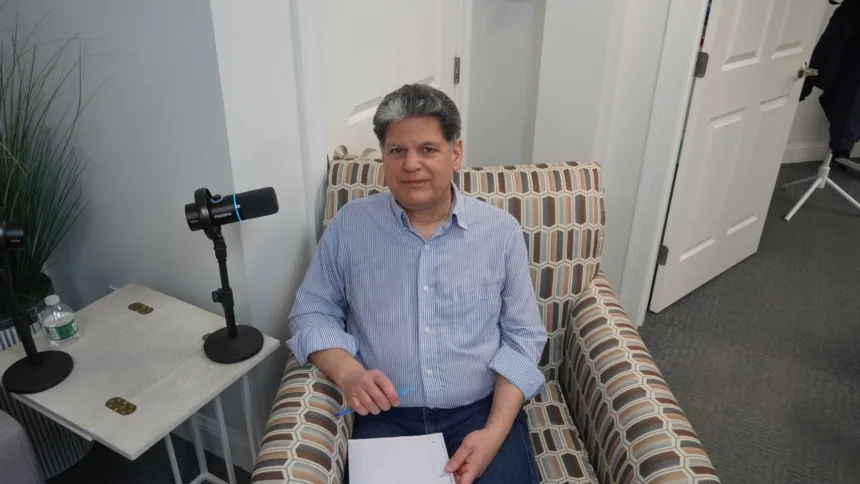
Select Board candidate Tony D’Arezzo used a recent public forum hosted by Reading Recap to outline his approach to town governance, emphasizing fact‑based decision‑making, collaboration, and a renewed focus on professionalism and civility on the Select Board.
D’Arezzo was one of three candidates to participate in the March 26th candidate forum ahead of the April 7th municipal election. The forum explored a wide range of town issues, including finances, infrastructure, development, public comment, and board conduct.
Background and Motivation for Office
In his opening statement, D’Arezzo described more than two decades of experience working for a large material‑handling company with operations across the Northeast. He said his role required working with a wide range of personalities, from technicians to executives, and making decisions based on data rather than emotion.
D’Arezzo said those professional experiences shaped his leadership style and motivated him to seek a seat on the Select Board, where he believes perspective, process, and careful analysis are essential.
Unified Sports and Article 14
When questioned about Article 14 of the Town Meeting warrant, which would allow funding for Unified Sports through revenue associated with Burbank Ice Arena, D’Arezzo said his support for the program itself is strong but expressed concern about how funding decisions are made.
He argued that Unified Sports should be included directly as a line item in the school department’s budget, rather than relying on uncertain or indirect funding sources. D’Arezzo said Town Meeting has the responsibility to appropriate funding once programs are formally included in departmental budgets and that doing so would provide greater accountability and consistency year to year.
Walkers Brook Drive and Traffic Planning
Addressing the proposed redesign of Walkers Brook Drive, particularly following the announcement that Trader Joe’s will locate in the area, D’Arezzo said updated traffic data is essential before moving forward.
He noted that earlier traffic studies may not have accounted for the additional supermarket and warned that Trader Joe’s locations typically generate significant vehicle traffic. While acknowledging the desire for improved sidewalks and pedestrian safety, D’Arezzo said design decisions must balance accessibility, traffic flow, and safety for all users.
D’Arezzo said he trusts town staff to continue evaluating options and stressed the importance of incorporating public input and real‑world usage patterns into final design decisions.
Budget Pressures and a Potential Override
On the topic of a potential operating override, D’Arezzo expressed appreciation for the work already done by town staff, department heads, and the Finance Committee to contain costs.
He said the town has reached a point where further cuts may jeopardize basic service levels. While acknowledging that an override is likely, D’Arezzo said any proposal should be structured to provide stability over multiple years to avoid repeated override requests.
D’Arezzo also said town leadership must begin identifying ways to reduce dependency on overrides by expanding the tax base through thoughtful development. With limited undeveloped land remaining, he said Reading will need to explore creative strategies to support long‑term financial sustainability.
Local‑Option Taxes
Asked about potential new local‑option taxes that could be authorized under proposed state legislation, D’Arezzo said any discussion of additional taxes must be tied to the broader context of the town’s financial needs.
He said the underlying question is how the town raises the revenue required to operate, whether through property taxes, excise taxes, or other mechanisms. D’Arezzo said such tools should be considered as part of an overall financial strategy, particularly when seeking to protect vulnerable residents from disproportionate impacts.
Board Conduct and Conflict Resolution
D’Arezzo devoted significant attention to the issue of Select Board conduct, saying disagreements should focus on ideas, policies, and processes rather than individuals.
He described effective leadership as setting the tone through example, correcting missteps when they occur, and reminding colleagues when discussions cross from substantive disagreement into personal conflict. D’Arezzo said trust on a board is built over time through consistent professionalism and a willingness to acknowledge mistakes.
He also referenced his own experience correcting a prior statement at an earlier forum, saying accountability and transparency are critical to maintaining public confidence.
Public Comment at Meetings
Turning to public comment, D’Arezzo said residents often want to respond to presentations or ask informed questions but are limited by existing meeting structures.
He suggested modest changes, such as slightly longer comment periods or improved explanations of public comment rules, could help reduce frustration while maintaining order. D’Arezzo emphasized that public comment should be directed to the board and that boards must clearly communicate whether comments will receive immediate responses or be taken under advisement.
Pleasant Street Center and Future Use
On the future of the Pleasant Street Center, D’Arezzo said the town must carefully weigh the costs of repurposing the building once the senior population transitions to the new Senior and Active Living Center.
He expressed concerns about the building’s infrastructure needs, including ventilation and long‑term maintenance, and said the town should revisit its earlier commitment to explore whether the site could help offset costs associated with the new facility.
D’Arezzo said he does not yet have a specific vision for the building’s future use but believes decisions must be grounded in realistic cost estimates and transparency with residents.
Goals for the New Town Manager
Asked about priorities for incoming Town Manager Jayne Wellman, D’Arezzo said his focus would be on promoting the town, supporting staff performance, and guiding Reading through upcoming budget decisions.
He emphasized the importance of planning for contingencies should an override fail and said proactive preparation is preferable to reactive decision‑making.
Closing Message
In his closing remarks, D’Arezzo urged residents to review the town charter and remain engaged in local government. He said the town faces complex challenges that can only be addressed if Select Board members work cooperatively and maintain focus on problem‑solving rather than personalities.
D’Arezzo encouraged voters to participate in early voting or on Election Day, April 7th, and said he hopes to bring a steady, thoughtful, and respectful approach to the Select Board if elected.
You can watch the full forum below. We’ll be highlighting each participant with individual articles over the course of the week.