

“Highlights equity, community trust, and continuity“
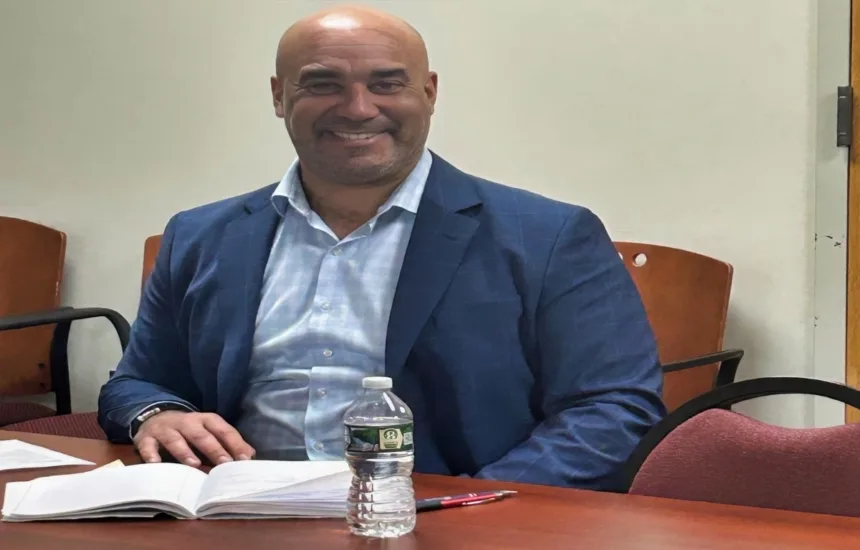
Henry Turner, a finalist for superintendent of Reading Public Schools and the longtime principal of Newton North High School, shared his leadership approach, experience, and priorities during a community engagement forum attended both in person and online.
Turner, who has served as principal of Newton North for the past 10 years, described spending the day meeting with principals, central office staff, department leaders, and town representatives, including a walk through the downtown area with the town manager. He emphasized his appreciation for Reading’s strong civic engagement and passion for public education.
It’s clear that this is a community that cares deeply about its schools,” Turner said. “That level of pride and involvement is something I’ve worked within my entire career.”
Background in Large, Complex School Leadership
Turner currently leads Newton North High School, a school of approximately 2,100 students and 400 staff members, including a large special education department. He described the role as comparable in complexity to running a small district, requiring both instructional and managerial leadership.
Over his career, Turner has worked in Lexington, Bedford, and Newton—districts known for strong academic expectations and high community engagement. He noted that while he is happy in his current role, he began exploring the superintendency as a natural next step after a decade at Newton North.
There are times professionally when it’s worth asking whether it’s time to stretch yourself,” he said. “You also want to make sure your leadership longevity isn’t holding back continued growth.”
Turner said Reading is the only superintendent search he has pursued, citing the district’s positive trajectory, alignment of values, and similarities to the community where he grew up.
Focus on Equity and Closing Opportunity Gaps
A central theme of Turner’s remarks was his focus on equity and belonging. He shared specific examples of work at Newton North to address disparities in student outcomes, access, and connection to school.
When he arrived at Newton North in 2016, Turner said data showed significant gaps in students’ sense of belonging and access to advanced coursework, particularly for Black students, students with disabilities, multilingual learners, and low‑income students. Over time, the school used data, relationship‑building, and instructional changes to narrow those gaps.
We were unwavering that it had to be about all kids,” Turner said. “All kids need to know they belong, that their voices are heard, and that adults in the building care about them.”
Turner pointed to increased enrollment and success in advanced courses, improved student‑reported connectedness, and post‑secondary outcomes as evidence of progress. He emphasized that equity work must be grounded in student outcomes rather than ideology and guided by continuous feedback.
Approach to Curriculum and Instruction
Turner addressed questions about instructional modeling, including multi‑level classes, describing a measured, teacher‑led approach that he said improved access without sacrificing rigor. He emphasized piloting changes, providing professional development, and adjusting based on results.
This work doesn’t happen overnight,” he said. “It requires trust, training, and being willing to adjust when something is hard.”
He added that instructional decisions should be informed by educators closest to the classroom and evaluated based on how well students are learning and progressing across different pathways.
Leadership Style Rooted in Collaboration
Throughout the forum, Turner described his leadership style as deeply collaborative. He said he views the superintendent role as encompassing three core areas: education, management, and community engagement, with relationship‑building central to all three.
He stressed the importance of working closely with principals, central office staff, families, and the School Committee, noting that effective leadership requires over‑communication and shared ownership of decisions.
In education, you should never be making decisions about students by yourself,” Turner said. “We do our best work when we make decisions together.”
Turner also discussed his experience with labor relations and budgeting, including navigating a teachers’ strike as both an administrator and parent. He said those experiences reinforced the importance of trust, transparency, and honest communication.
Vision for the First Year
Looking ahead, Turner said his first year as superintendent would focus on listening, learning the Reading community, and supporting the work already underway. He noted the district is nearing the end of its current strategic plan and said that continuity and careful planning would be essential.
My goal would be to learn the community, support educators, and continue strong initiatives already in place,” he said. “From there, I would help guide a collaborative process to develop the next strategic plan.”
Turner concluded by thanking residents for their thoughtful questions and engagement, calling the forum itself a reflection of the district’s values.
“The number of people here and the quality of the questions show how much you care,” he said. “That’s exactly the kind of community I want to serve.”