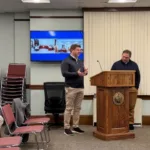


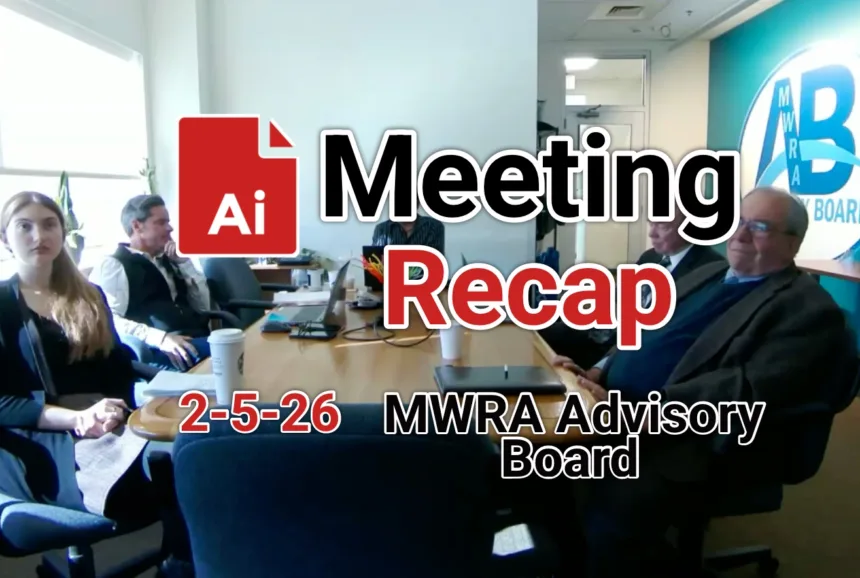
Below is a summary of Reading’s discussion from the February 5, 2026 meeting, organized by key speakers and their main points. The meeting involved the MWRA (Massachusetts Water Resources Authority) Executive Committee and Advisory Board, discussing Reading’s entry fee relief regarding the fairness of entrance fees paid by the Town of Reading. Timestamps correspond to the video linked at the bottom.
Contents
🔹 Opening of Meeting
🕒 0:00–1:30
- Meeting called to order at 10:05 AM, held in-person and remotely.
- Standard roll call, voting procedures, and meeting protocols reviewed.
- Quorum confirmed.
🔹 MWRA Response to Advisory Board Inquiry on Reading’s Entrance Fee Relief Request
🕒 1:30–12:00
Background
- The Town of Reading renewed its request for entrance fee relief, arguing it paid for more water capacity than it ultimately used.
- MWRA staff delayed final response due to overlapping workload, including CSO long-term control plan updates.
MWRA Staff Presentation
- Colleen Rizzi reviewed:
- Entrance fee calculation policies under Operating Policy 10.
- Reading paid its entrance fee as a lump sum, not through MWRA financing.
- Only one precedent exists: Stoughton, which received an interest-rate adjustment—not a refund—because they had financed through MWRA.
- Matt Horan (Deputy Finance Director) provided financial modeling:
- Full reimbursement to Reading would add 3%+ to FY27 water assessment rates.
- If all past entrance-fee communities sought refunds, the total impact would be 7.8% added to the existing projected 3.9%rate increase.
- Using rate stabilization funds is not viable; would set precedent and drain reserves.
Committee Takeaways
- No existing mechanism allows MWRA to refund Reading under current rules.
- Any relief would require:
- Advisory Board recommendation, and
- MWRA Board of Directors approval.
🔹 Public Comment (Expanded)
🕒 12:00–23:00
Jayne Wellman (Assistant Town Manager)
- Explained why Reading requested 766 MGY despite using ~608 MGY:
- Community faced severe pressure from the Ipswich River Basin, which was environmentally stressed.
- Required by regulators to adopt strong conservation measures, lowering demand.
- Reading purchased a “conservative” higher capacity due to:
- State pressure
- Environmental group advocacy
- Uncertainty about future use
- Reading now seeks $2.2M return (difference between paid capacity and actual use), not the original $11M request.
Matt Kraunelis (Town Manager)
- Stated Reading is one of only six communities to ever pay an entrance fee.
- Argued Reading’s fee was the highest and imposed an unfair burden.
- Reading reduced request from $11M to $2.2M in good faith.
- Expressed frustration at delays and signaled Reading may pursue legal avenues if relief is denied.
Paul Silva (Resident)
- Cited the MWRA Enabling Act’s requirement that entrance fees reflect “proportionate investment.”
- Argued Reading overpaid relative to actual water volume used.
- Noted agreements require communities exceeding their contracted volume to pay more—yet underuse provides no mechanism for refund, which he argued is inequitable.
🔹 Advisory Board Member Discussion
🕒 23:00–34:00
Key Themes
- Members acknowledged Reading’s concerns but emphasized:
- Reading purchased a right to use water capacity, which had value at the time.
- “Unused capacity” ≠ “refund obligation.”
- Changing policy now would:
- Set precedent
- Create ripple effects
- Require substantial reworking of policy
- Some members suggested Reading had indeed fully used partial admission volumes early on, complicating the claim.
Member Views
- Most members leaned against revising policy.
- Some argued the issue raised larger questions worth future policy review—but not retroactive refunds.
🔹 Consideration of Motion to Explore Policy Changes
🕒 34:00–36:00
Motion Language
A YES vote would direct staff to explore policy modifications allowing entrance-fee relief based on unused volume.
A NO vote would close the matter with no further action.
🔹 Vote
🕒 36:00–35:24 (vote recorded retroactively)
Outcome: Motion FAILED
- YES — 3
- NO — 8
- Abstentions — 0
Motion failed; no policy work will be initiated.
Key Outcomes
- MWRA will NOT pursue policy changes to allow entrance-fee relief for underuse.
- Reading’s request is effectively closed at the executive committee level.
- A formal letter will be issued to Reading documenting the decision.
- Reading representatives indicated they may pursue other avenues (legal or legislative).