Depot Cam
 Override 2026
 Shop 01867
 AI Recaps
 LTE’s
LTE’s Police and Fire Scanner
 Search & Ask Recap AI
Symbolic Vote Sends Clear Message to MBTA: Rethink the Turnback Track Location
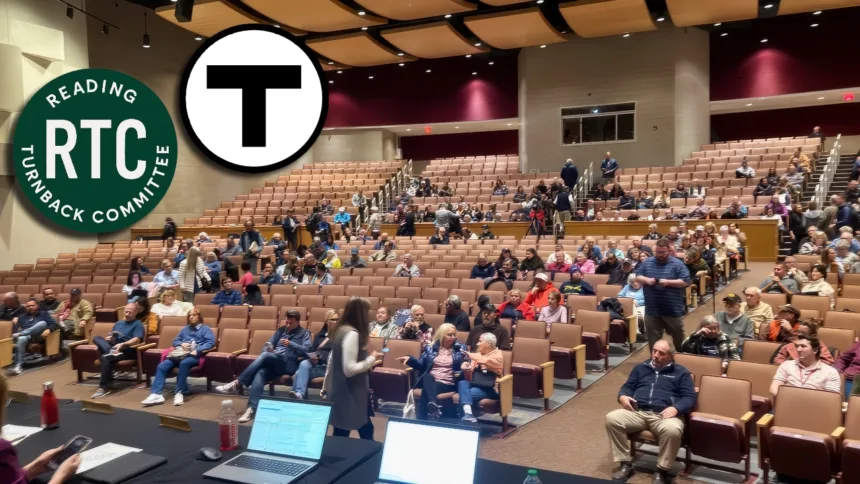
In a packed and emotionally charged special meeting on Monday night, Reading residents, town officials, and MBTA representatives gathered to discuss the Massachusetts Bay Transportation Authority’s (MBTA) proposed turnback track project. The meeting, hosted by the Select Board, drew hundreds of concerned citizens, many of whom voiced strong opposition to the plan, citing environmental, health, safety, and quality-of-life concerns.
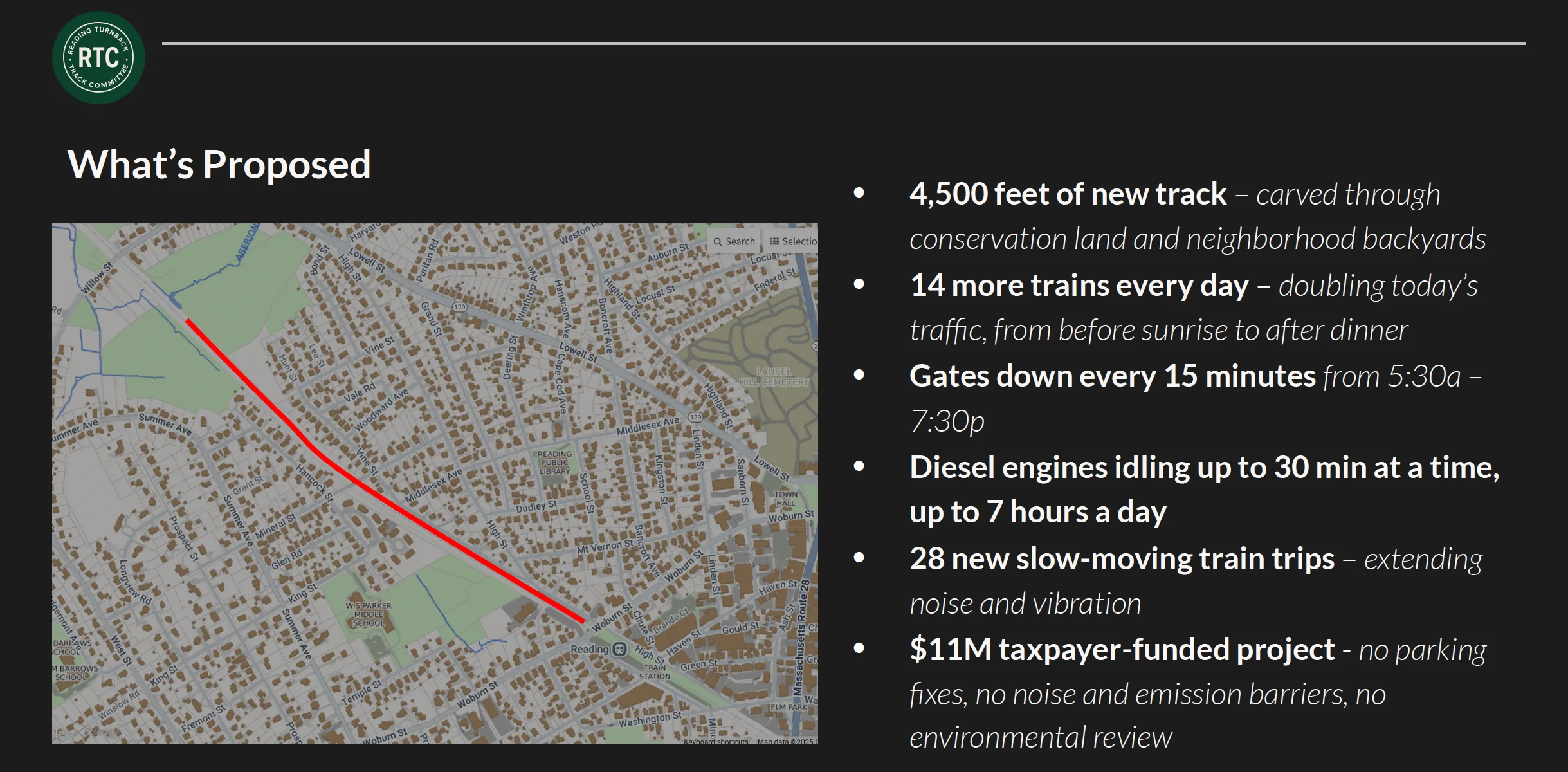
The proposed project would add a 4,500-foot turnback track near the Reading commuter rail station, increasing train movements by 28 trips per day and resulting in up to seven hours of daily idling by diesel locomotives in residential neighborhoods and conservation areas.
Community Voices Unite
Lucas Prato, a Reading resident and member of the Reading Turnback Track Committee (RTC), opened the presentation by emphasizing the group’s support for improved rail service but opposition to the proposed location. “We want to see the MBTA succeed,” Prato said, “but not at the cost of our families’ health and safety.”
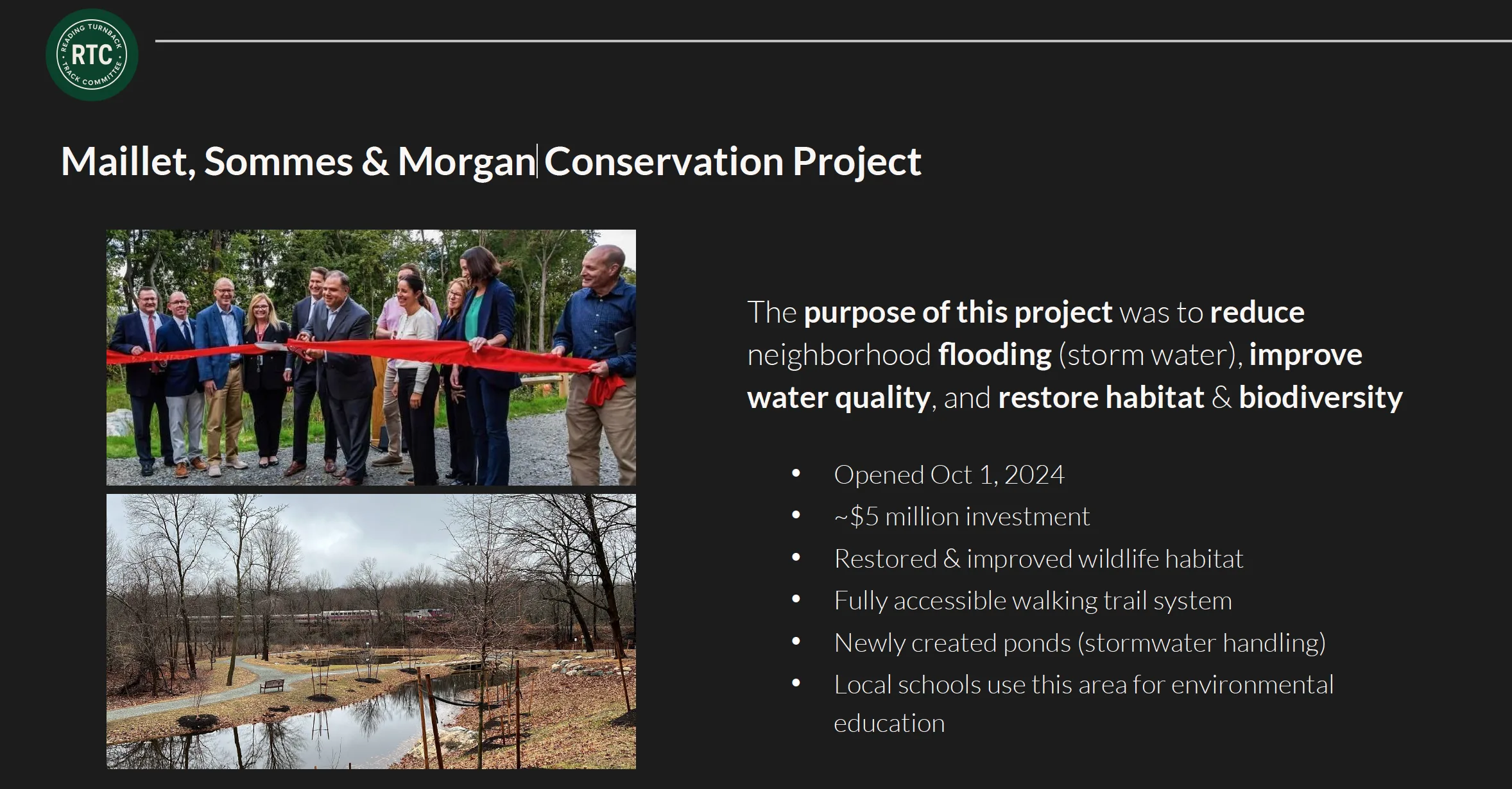
Aaron Parry, another RTC member, detailed the environmental risks, including increased diesel emissions near sensitive areas such as Parker Middle School, the Tannerville Elderly Independent Living Center, and the newly restored Maillet, Sommes & Morgan Conservation Land. “This isn’t a repair—it’s a major expansion,” Parry said. “And it’s happening in the heart of our community.”
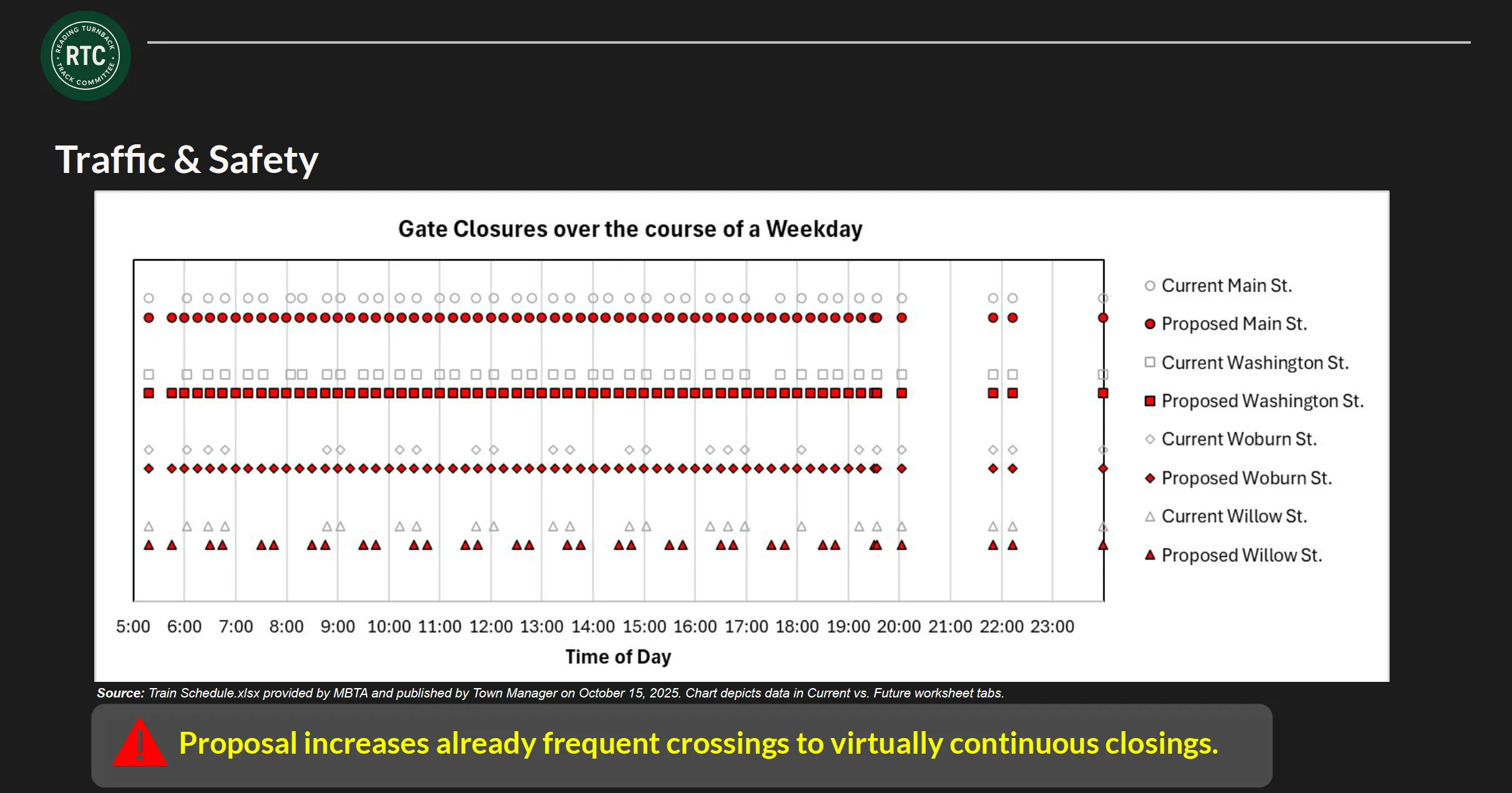
Mark Agami, a lifelong Reading resident, presented an animated simulation of the proposed train schedule, illustrating how frequent idling and gate closures would disrupt traffic and violate state idling laws. “The train is stationary more than 60% of the time,” Agami noted. “Moving is the whole point of a train.”
Allie Hettler, a mother of two and recent Reading resident, raised concerns about emergency response times, noting that the town has only one ambulance located on the north side. “Can your emergency wait for a train to pass by?” she asked, highlighting the potential life-threatening consequences of delayed medical care.
Public Comment: A Chorus of Concern
Following the RTC’s presentation, more than 50 residents signed up to speak during the public comment portion, which lasted about an hour and a half. The speakers represented a cross-section of the community—parents, seniors, business owners, students, and town officials—many of whom live near the proposed track.
Concerns ranged from increased air and noise pollution to traffic congestion and emergency response delays. Residents described the impact of diesel fumes on vulnerable populations, including children and the elderly, and questioned the MBTA’s environmental assessments and sound studies.
Kaden Barcikowski, an 11-year-old student at Parker Middle School, spoke passionately about his love for the conservation land near his home and his fears that pollution would ruin it:
People go down to the conservation land to enjoy peace and quiet,” he said. “That would be disturbed if trains are polluting the area.”
Justin Perry, a resident of Whittier Road, criticized the MBTA’s approach to the project and its lack of market understanding:
The MBTA is attempting to address its issues by adding more trains, fixing their problems, and creating new problems for us,” Perry said. “They could use this funding to enhance ridership without contributing to air pollution or compromising emergency services and our safety.”
Resident Joy Beaulieu, who also owns a business across from the train station asked whether the Select Board’s vote would have any real impact on the MBTA’s plans. Haley clarified that the vote was largely symbolic. Beaulieu followed up, asking whether the Select Board had any power at all. Haley responded, “I think the largest crowd I’ve seen in this building—beyond the RMHS Drama Club and other shows—sends its own message more than I’m going to.”
Several residents called for the MBTA to consider alternative locations for the turnback track, such as the 93/129 site north of Causeway Road, which they argued would have less impact on residential neighborhoods and protected lands.
MBTA Briefly Responds
The MBTA was also invited to the meeting and granted equivalent presentation time as the RTC. Instead, Ryan Coholan, the MBTA’s Chief Operating Officer, attended the meeting with other MBTA officials stated:
Tonight was a fact-finding mission,” Coholan said. “No final decision has been made. We’re here to listen and explore every alternative.”
Despite the MBTA’s assurances, many residents remained skeptical, urging the agency to conduct comprehensive environmental reviews and to publicly address the concerns raised during the meeting.
Select Board Takes a Stand
After the public comment portion, the Select Board took a decisive stance, voting unanimously 5-0 to oppose the MBTA’s proposed turnback track location. While the vote itself was symbolic, it reflected the board’s alignment with the concerns voiced by residents throughout the evening.
Board Member Carlo Bacci noted the significance of the community turnout, referencing the packed room:
There were about 350 people in this room. I counted,” he said. “A lot left, but I was going to take a poll on how many saw this presentation for the first time, and my guess is it would have been a good 20, 30, 40%.”
Co-Chair Chris Haley, whose office overlooks the Reading train depot, shared his firsthand experience with the impact of train idling:
It is beyond obnoxious,” Haley said. “We heard the audio here tonight. It’s even worse in person and residents are going to hear this all day.”
He emphasized that the issue wasn’t just about train service, but about the location and its consequences for the community.
Other board members echoed the sentiment, praising the RTC’s thorough presentation and expressing frustration over the MBTA’s lack of transparency. Co-Chair Melissa Murphy criticized the agency’s approach, saying:
They tried to sneak it in without notifying the abutters or contacting our town manager. From the get-go, it put a really bad taste in all of our mouths.”
Despite the strong opposition, the Select Board acknowledged that the decision to proceed ultimately rests with the MBTA. The board has no formal authority over the transit agency, and the town’s Conservation Commission is limited to voting only on the specific project presented to them. As such, the Select Board’s vote serves primarily as a public statement of the town’s position and a call for greater accountability and collaboration.
Looking Ahead
While the Select Board’s vote is largely symbolic, it sends a strong message to the MBTA and state officials. Residents and town leaders vowed to continue advocating for transparency, accountability, and a solution that balances improved transit service with the health and safety of the Reading community.
The complete video can be seen below: