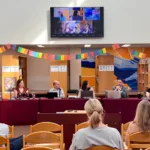


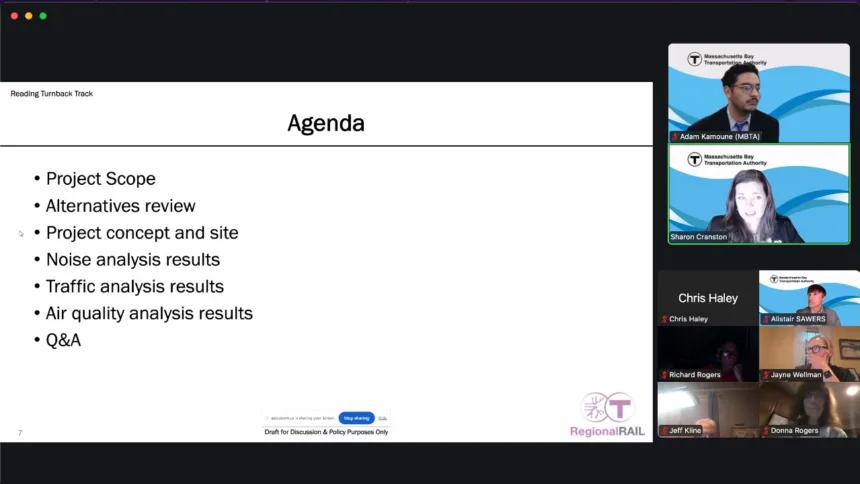
Below is a summarized version of the MBTA Turnback Track public meeting, organized in order, focusing on key points raised during the discussion in Reading, Massachusetts. This summary condenses the discussion into major themes, speaker contributions, and decisions, avoiding excessive detail while retaining the essence of the conversation. The full video is linked at the bottom.
🛤️ Project Overview: Haverhill Line Turnback Track
The MBTA is proposing a new turnback track just north of Reading Station to support its Rail Modernization Program. The goal is to enable 30-minute service intervals between Reading and Boston, compared to the current 45-minute intervals. Beyond Reading, service would shift from 90 minutes to 60 minutes.
Currently, trains turn at Reading Station on a single track, which creates bottlenecks and limits the ability to run more frequent service. The new turnback track would allow trains to reverse direction without blocking the main line, enabling bidirectional, all-day serviceand improving reliability for commuters, reverse commuters, and off-peak riders.
The MBTA aims to implement this service change by Fall 2026, assuming construction proceeds on schedule.
📍 Site Selection & Community-Suggested Alternatives
The MBTA evaluated six alternative locations for the turnback track based on community feedback:
- Within Reading Station – Rejected due to ADA compliance requirements. Adding a second platform would trigger a full station upgrade, which is unfunded and would take 6+ years.
- South of Reading Station – Operationally unfeasible due to the need for multiple train turns within a 30-minute window.
- North of Reading near Wildcat Branch – Too far from the station to meet timing requirements; also located in wetlands.
- Under I-93 – Similar timing and environmental issues as the Wildcat Branch.
- Routing trains via Wildcat Branch – Not viable due to shared use with Amtrak and freight, and insufficient capacity.
- Relocating the station south of Market Basket – Would require full environmental and property reviews and disconnect the station from walkable areas.

The preferred site is on MBTA-owned land within conservation land north of Reading Station, using a historic second track bed. This location minimizes property impacts and is farther from sensitive community features like schools and housing.
📊 Environmental & Technical Analysis
🔊 Noise Study
- Conducted by a certified acoustical engineer using calibrated microphones at three locations.
- A train was idled for 20 minutes to simulate turnback operations.
- Results showed 1–6 dB increases, which are within acceptable limits and do not exceed MassDEP criteria.
- The increase is perceptible but not disruptive to conversation or daily life.
🌬️ Air Quality
- MBTA is transitioning to renewable diesel, which significantly reduces particulate emissions (linked to asthma and respiratory issues).
- Nitrogen oxide (NOx) emissions increase slightly but remain well below EPA thresholds.
- Renewable diesel is already being piloted and will be implemented on the Haverhill Line before the turnback track is operational.

🚦 Gate Closures
- More frequent train movements will increase gate activations at crossings (e.g., Washington St, Main St, Willow St).
- However, each closure will be shorter due to optimized gate timing and faster train movements.
- MBTA is actively reviewing gate data to reduce anomalies and improve efficiency.
🚉 Service Impact & Operations
- The turnback track will allow 8 trains per day to reverse direction north of Reading Station.
- Operations will occur between 5:30 AM and 7:30 PM on weekdays only.
- The turnback procedure involves switching control from the locomotive to the cab car and performing safety checks.
- This infrastructure is essential to achieving clock-face scheduling (e.g., trains arriving at predictable times like 10:00, 10:30, etc.).
🧑🤝🧑 Community Feedback & Concerns
❗ Concerns Raised:
- Noise and pollution near residential areas.
- Environmental impact on conservation land and wetlands.
- Lack of ADA compliance at the current station.
- Skepticism about midday ridership demand.
- Desire for improved peak-hour service rather than all-day frequency.
✅ Support Expressed:
- Residents cited the need for reliable, frequent service for non-traditional commuters, students, and medical appointments.
- Some emphasized the benefit of reducing car traffic and pollution.
- Others noted the potential for increased ridership due to new housing developments near the station.
MBTA officials reiterated that the turnback track is not a service mandate, but a flexible infrastructure that enables future service improvements. They also emphasized that community feedback will continue to shape schedules and that the project does not preclude future station upgrades.
📅 Timeline & Future Plans
- Fall 2025: MBTA plans to submit a revised Notice of Intent to the Reading Conservation Commission.
- Spring 2026: Construction expected to begin, pending environmental approvals.
- Fall 2026: New schedule with 30-minute service intervals to be implemented.
🔋 Electrification
- MBTA is piloting battery-electric trains on other lines and plans to expand to the north side (including Reading) in the 2030s, pending funding.
- Electrification will require additional infrastructure like substations and charging facilities.